The first question when a change directive lands


What happens on site
A change directive is an order to proceed before price and time are agreed. The crew starts the changed work the same week. The form has a field for schedule impact, and it is blank, because nobody knows yet.
Nobody stops the job over it. You raise the point, you put it in writing that the work continues and that there will be charges, and the crew keeps moving. That part is done right. What comes next is not.
Then the paperwork catches up. Pricing, review, negotiation, sign-off. Meanwhile the project manager runs the monthly schedule update and leaves the directive out of it, because there is still no number of days to put on it. So the schedule is current and wrong at the same time.
The first question, the day the directive lands
Before the price, before the exact scope, one question comes first. Does anything else wait on the task it touches? If there is a chance the answer is yes, treat it as a yes.
If it is yes, you tell the owner that day. You write down the dates, you keep the written exchanges, you build the file. Weeks later somebody will ask you to justify every day of delay, and you build that proof now.
If it is no, that is not nothing. There is still extra work to bill, one more door that was not on the drawings. You bill it, you hang it, and you still finish on the date you planned. A yes and a no are not the same day of work.
What decides the answer
What decides is the link in the schedule, not an opinion. If the cabinets cannot start before the paint is done, the paint carries the cabinets. If nothing waits on a task, whether it takes six weeks or eight changes nothing at the end of the job. A well-linked schedule answers this on its own, as long as somebody put the links in.
And a no can turn into a yes. Float is the time a task can slip before it delays the next one. The time to settle the directive adds to the time to do the work, and together they can run past it. You give three weeks to approve shop drawings, it takes five, and the steel cannot start before that. A task that carried nothing starts carrying everything after it.
A directive adds work. The task it touches takes longer, or has to happen in a different order. And when changes pile up, the whole site slows down, even the tasks that did not change. In a study of 226 projects, once changes passed 15 to 20 percent of the contract value, no site kept its planned productivity. And 10 percent is common: four projects in ten were past it.
And the time field left blank on the directive? Blank means unknown, not zero. A blank field is not an answer to the question. Reading it as zero is how a change that started on Tuesday waits seven weeks before it reaches the schedule.
Answer it the same day
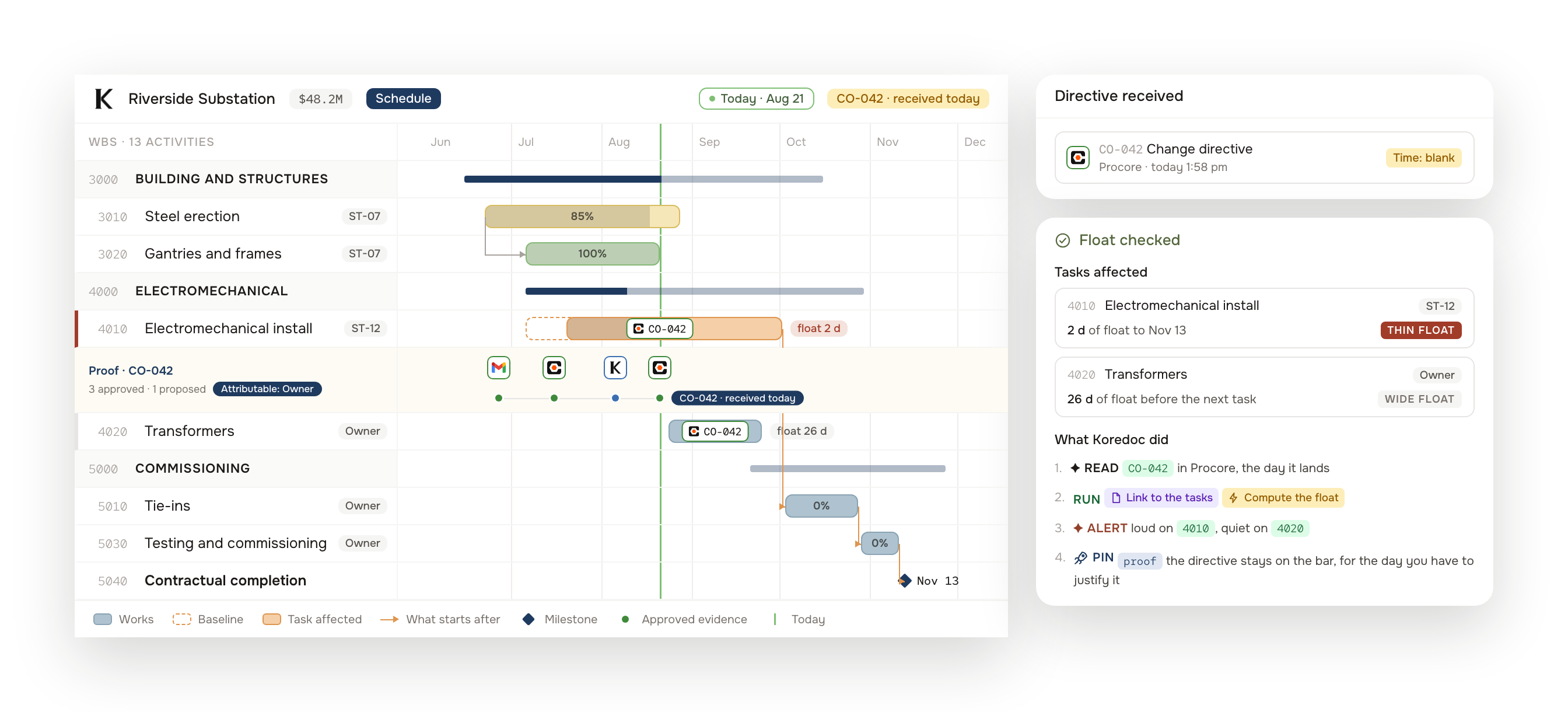
The problem is not the directive. It is the seven weeks when nobody looks at what depends on the task it touches. A schedule that reads documents changes that. With Koredoc, the directive is read the day it arrives and tied to the tasks it affects. You see what depends on each one and how much float is left, for every milestone. The alert comes the same day, loud when float is thin, quiet when it is wide. And the directive stays pinned to the bar, for the day you have to justify it.
Sources: HKA CRUX Insight, 8th annual report, 2025, 2,204 projects in 114 countries. Dodge Construction Network, Optimizing the Change Order Process for Specialty Trade Contractors, SmartMarket Insight, US, 2026. Ibbs, Construction Change: Likelihood, Severity, and Impact on Productivity, 2012, 226 projects in 12 countries, mostly large industrial work.